Japanese vs English Pokémon Cards: Key Differences, Values, and More
Wondering whether English or Japanese Pokémon cards are the right fit for your collection?
The same Pokémon card artwork can feature different set numbers, rarities, release formats, and—most importantly—different market values depending on whether it is printed in Japanese or English. If you don't know the key differences between the two markets, it’s easy to overpay, misidentify a chase card, or buy a sealed product that doesn't align with your goals.
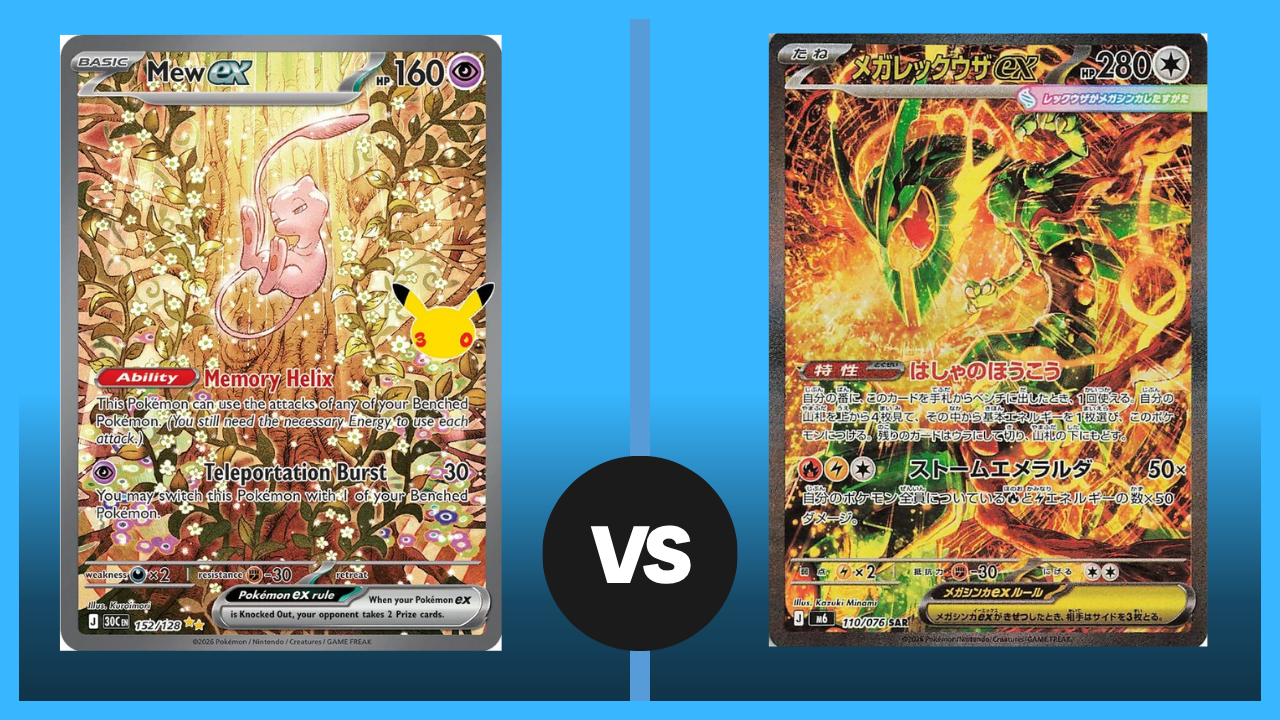
So, which version should you actually buy?
Japanese releases typically offer early access, premium print finishes, and highly sought-after regional exclusives. Meanwhile, English cards offer tournament playability, wider retail availability, and notoriously strong resale demand in the Western secondary market.
Japanese vs English Pokémon cards: 11 Core Differences
Japanese and English Pokémon cards differ on a structural, physical, and economic level. Here is how they stack up straight out of the pack.
| Feature | Japanese Pokémon Cards | English Pokémon Cards |
|---|---|---|
| Thickness & Weight | Thinner (~0.28 mm) and slightly lighter (~1.5 g). More flexible. | Thicker (~0.31 mm) and slightly heavier (~1.55 g). Firmer feel. |
| Print & Texture | Sharper details, deeper saturation, incredibly fine fingerprint-like texture. | Beautifully produced, though texturing is often chunkier or more pronounced. |
| Condition Consistency | Stellar out-of-the-pack centering and clean-cut edges. | Can experience slightly more factory variance in centering or edge cuts. |
| Set Structure | Smaller, focused sets released frequently (usually monthly). | Massive, comprehensive sets combining 2-3 Japanese sets at once. |
| Release Timing | The global premiere. Sets debut here first. | Released internationally weeks or months later. |
| Exclusives | Heavy emphasis on Pokémon Center promos and tournament trophy cards. | Retailer exclusives (Best Buy, GameStop) and prerelease promos. |
| Standard Pack Format | Standard sets: 5 cards per pack / 30 packs per box. High Class sets: 10 cards per pack / 10 packs per box. |
10-11 cards per pack / 36 packs per box. |
| Pull Distribution | Guaranteed box hits (e.g., exactly 3 ARs, 1 SR/SAR per box). | Randomized distribution. No guaranteed box ratios. |
| Tournament Legality | Restricted outside of Japanese-speaking regions. | The standard for international competitive play. |
Pack formats, pull distributions, thickness and weight may vary by set, rarity and product type. They should be checked at the product level rather than treated as universal differences between the two languages.
Print Quality & The "PSA 10 Premium"
Japanese cards are renowned in the hobby for their immaculate print quality. The colors are deep, the foil is vibrant, and the surface texturing on Special Illustration Rares (SIRs) is incredibly refined. Straight out of the pack, a Japanese card is highly likely to have excellent centering and clean edges.
English cards, however, are manufactured to meet massive global demand, which can sometimes lead to slightly higher factory variance. While still gorgeously produced, things like minor off-centering or edge wear can occur a bit more frequently in English prints.
The Market Reality: Because English cards can be slightly harder to pull in flawless condition, an English PSA 10 chase card will often command a "Grade Premium" over its Japanese PSA 10 equivalent. The Japanese raw card is known for high quality, but the English perfect 10 is statistically rarer on the grading scale.

Umbreon ex - 161/131
Prismatic Evolutions • Special Illustration Rare
Market Value
Loading...

Umbreon ex - 217/187
SV8a: Terastal Fest ex • Special Art Rare
Market Value
Loading...
Set Size, Release Structure, and the "Master Set" Challenge
Japanese sets are hyper-focused. They are generally much smaller and release more frequently (almost monthly). English expansions, on the other hand, are massive compilations designed to sustain quarterly release schedules.
This creates a distinct experience for "Master Set" collectors. Completing a Japanese set is a focused, achievable sprint. Completing a modern English set, however, can be more of a marathon.
| Feature | Japanese Sets | English Sets |
|---|---|---|
| Set size | Generally smaller (focused card pools). | Generally much larger. |
| Release frequency | More frequent (almost monthly). | Less frequent (quarterly mainline sets). |
| Card pool | Focused, standalone thematic releases. | Often combine multiple Japanese releases. |
| Master-set collecting | Fewer cards per set to track down. | Massive checklists require more packs to complete. |
That being said, while recent English releases have been more streamlined compared to past eras, completing an English master set typically still requires tracking down more cards than its Japanese counterpart.
Decoding Set Codes, Card Numbers, and Rarities
If you are searching for singles on the secondary market, you must understand how the two languages categorize the exact same artwork. English and Japanese versions assign completely different set codes, collector numbers, and rarity acronyms to the same card.
For example, what English collectors know as an Illustration Rare (IR) or Special Illustration Rare (SIR), the Japanese market labels as an Art Rare (AR) or Special Art Rare (SAR). If you search eBay using the wrong regional terminology, you will miss out on listings.
| Feature | Japanese Cards | English Cards |
|---|---|---|
| Set codes | Uses specific alphanumeric codes (e.g., SV2a, SV4a). | Uses separate English set abbreviations (e.g., MEW, PAF). |
| Collector number | Based entirely on the smaller Japanese card pool. | Renumbered to fit the expanded English checklist. |
| Modern rarities | Uses AR, SAR, and UR acronyms. | Uses labels such as Illustration Rare and Special Illustration Rare. |
| Promo numbering | Maintains a dedicated Japanese promo system. | Maintains a separate English Black Star Promo system. |
Release Timing and the "Information Advantage"
Japanese sets almost always launch before their localized English counterparts. However, there is no standardized gap. The delay can range from a few weeks to several months.
This creates a massive "Information Advantage" in the TCG market. Because the Japanese market gets the cards first, international players and investors use the Japanese secondary market as a crystal ball to predict which cards will be the highest-valued chase cards when the English set finally drops.
| Set Example | Japanese Release | English Release | Approximate Gap |
|---|---|---|---|
| Pokémon Card 151 ➔ Scarlet & Violet—151 | June 16, 2023 | September 22, 2023 | 98 days |
| Terastal Fest ex ➔ Prismatic Evolutions | December 6, 2024 | January 17, 2025 | 42 days |
Exclusive Cards and Regional Promos
Both markets receive exclusive promotional cards, but their distribution methods dictate their long-term value. Japan relies heavily on limited-run store campaigns, tournament-exclusive trophy cards, and Pokémon Center lotteries. This inherently restricts supply.
The English market relies more on wide-release retailer promos (like GameStop or Best Buy stamped cards) or League promos. While regional English exclusives are highly desirable, true scarcity is much more common in the Japanese promo ecosystem.
| Feature | Japanese Cards | English Cards |
|---|---|---|
| Common exclusives | Event, campaign lotteries, and Pokémon Center promos. | Product bundles, League play, and retailer promos. |
| Release area | Primarily restricted to Japan. | International or specific Western regional markets. |
| English equivalent | May be delayed indefinitely or remain permanently unavailable. | May use different artwork or holographic stamps. |
| Collector appeal | Extremely strong for Japan-exclusive art releases. | Strong for regional stamped cards and vintage promos. |
Pull Rates & Hit Distribution (The Economics of the Box)
If you are ripping sealed products, understanding the difference in pull distribution is key to managing expectations.
Japanese booster boxes are seeded. A standard Japanese box mathematically guarantees a specific floor of hits—usually three Art Rares (AR) and exactly one Secret Rare (SR) or better. You know the baseline output of that box before you even open it.
English booster boxes offer a completely randomized experience. There are zero guarantees. You might open an incredible box loaded with multiple SIRs and Hyper Rares, or you might open one with a quieter selection of hits. If you prefer the thrill and gamble of high-variance openings, English is the way to go. If you want a structured, guaranteed return on your box opening, Japanese is an excellent choice.
Availability and True Landed Cost
When evaluating whether to buy Japanese or English sealed products, you cannot simply compare the retail prices side-by-side. You have to calculate the total "Landed Cost."
English products are heavily distributed in Western markets, meaning you can often buy them locally at MSRP (or slightly below) with zero shipping costs. Japanese booster boxes often have a lower retail price domestically in Japan, but the cost of getting them to your door changes the math entirely.
When you factor in international shipping, proxy service fees, import duties, and currency exchange rates, the final price per pack for Japanese cards can quickly eclipse the cost of buying English cards locally. Always calculate the true landed cost before assuming Japanese boxes are the cheaper option.
Are Japanese Cards Worth More?
There is a misconception that language alone dictates value. In reality, scarcity and distribution mechanics dictate value.
When Japanese Cards Win: Japanese cards carry notable premiums when their distribution is restricted. Tournament prize cards, limited Pokémon Center lotteries, and magazine promos that never saw an English release are highly prized by niche collectors.
When English Cards Win: English cards typically dominate broad retail chase markets. A modern English Special Illustration Rare will frequently outsell its Japanese counterpart because the English buyer base is exponentially larger, and the sheer volume of English-speaking players driving demand creates massive market liquidity.
Translating Japanese Sets to English Equivalents
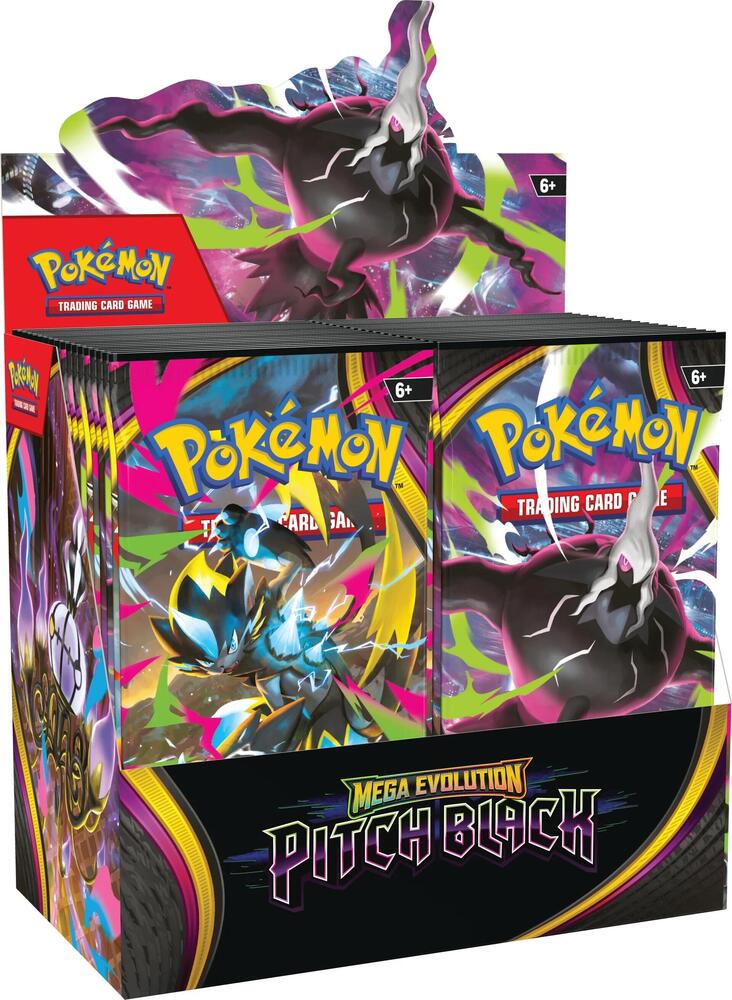
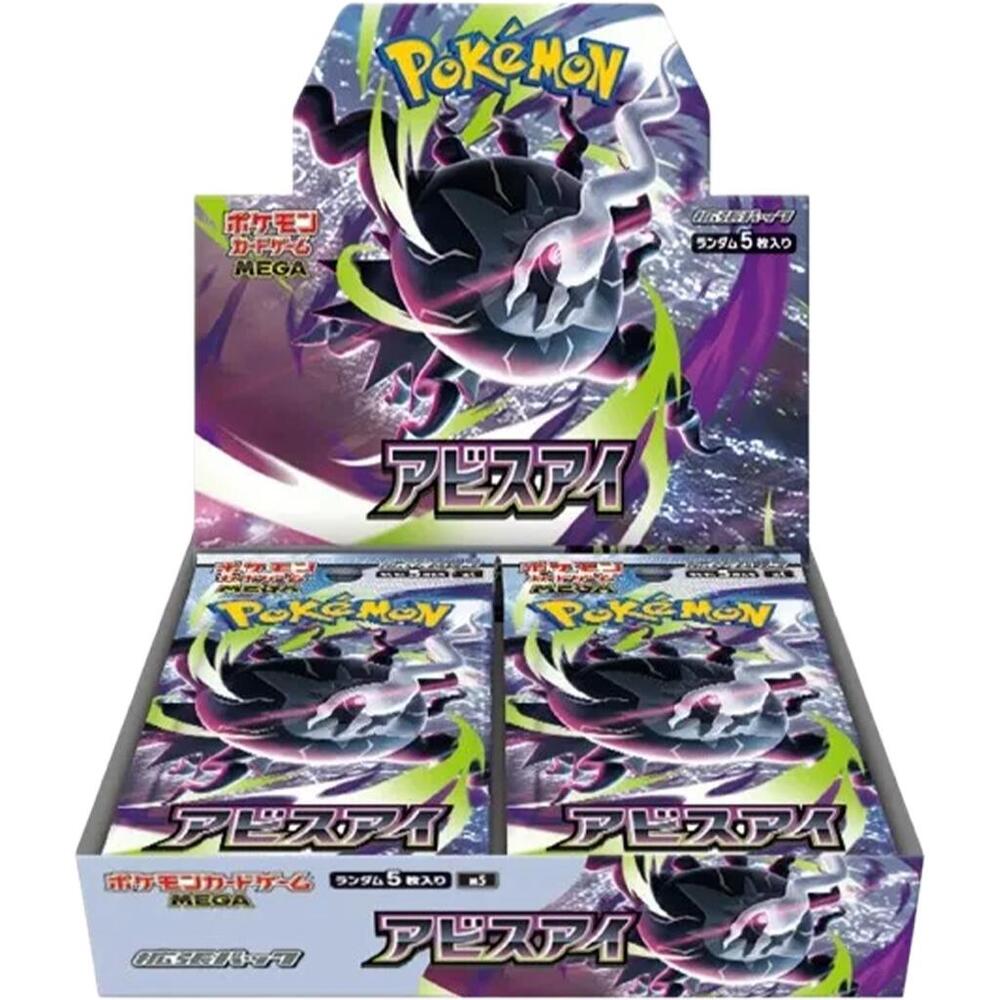
Because English expansions are comprehensive releases that combine 2 to 3 smaller Japanese sets (along with special promos and starter decks), tracking down the exact English equivalent of a specific Japanese chase card takes a bit of navigation.
Scarlet & Violet and MEGA Eras
| Japanese Source Sets | English Release |
|---|---|
| Scarlet ex / Violet ex | Scarlet & Violet Base |
| Triplet Beat / Snow Hazard / Clay Burst | Paldea Evolved |
| Pokémon Card 151 | Scarlet & Violet—151 |
| Ruler of the Black Flame | Obsidian Flames |
| Raging Surf / Ancient Roar / Future Flash | Paradox Rift |
| Shiny Treasure ex | Paldean Fates |
| Wild Force / Cyber Judge | Temporal Forces |
| Crimson Haze / Mask of Change | Twilight Masquerade |
| Night Wanderer | Shrouded Fable |
| Stellar Miracle | Stellar Crown |
| Paradise Dragona / Super Electric Breaker | Surging Sparks |
| Terastal Fest ex | Prismatic Evolutions |
| Battle Partners | Journey Together |
| Heat Wave Arena / Glory of Team Rocket | Destined Rivals |
| Black Bolt / White Flare | Black Bolt and White Flare |
| Mega Brave / Mega Symphonia | Mega Evolution |
| Inferno X | Phantasmal Flames |
| MEGA Dream ex | Ascended Heroes |
| Nihil Zero | Perfect Order |
| Ninja Spinner | Chaos Rising |
| Abyss Eye | Pitch Black |
| Storm Emeralda | Delta Reign |
Sword & Shield Era
| Japanese Source Sets | English Release |
|---|---|
| Sword and Shield | Sword & Shield Base |
| Rebellion Crash / VMAX Rising | Rebel Clash |
| Infinity Zone / Explosive Walker | Darkness Ablaze |
| Amazing Volt Tackle / Legendary Heartbeat | Vivid Voltage |
| Shiny Star V | Shining Fates |
| Single Strike Master / Rapid Strike Master | Battle Styles |
| Silver Lance / Jet-Black Spirit / Peerless Fighters | Chilling Reign |
| Skyscraping Perfection / Blue Sky Stream / Eevee Heroes | Evolving Skies |
| Fusion Arts | Fusion Strike |
| 25th Anniversary Collection | Celebrations |
| Star Birth | Brilliant Stars |
| VMAX Climax | Distributed into Trainer Galleries (Astral/Lost/Silver) |
| Time Gazer / Space Juggler / Battle Region | Astral Radiance |
| Lost Abyss / Dark Phantasma | Lost Origin |
| Paradigm Trigger / Incandescent Arcana | Silver Tempest |
| VSTAR Universe | Crown Zenith |
The Sword & Shield era is where set mapping gets truly chaotic. Eevee Heroes, for example, had its cards scattered across multiple English expansions. Meanwhile, the legendary VMAX Climax High Class set never even became a standalone English release. Instead, its highly desirable Character Rares and Character Super Rares were broken up and seeded into the Trainer Galleries of Brilliant Stars, Astral Radiance, Lost Origin, and Silver Tempest.
Which Should You Collect: Japanese or English Pokémon Cards?
Ultimately, the "best" version to collect depends entirely on your goals in the hobby. Are you prioritizing display collecting, competitive gameplay, or long-term resale liquidity?
Japanese cards are typically the superior choice for collectors hunting original release prestige, intricate foil textures, and regional exclusives. English cards are the standard for competitive play, readability, local retail availability, and moving high-end graded cards on the international secondary market.
| Collector Priority | Recommended Choice | Main Reason |
|---|---|---|
| Artwork and texture | Japanese | Often preferred for detailed foil and premium texture presentation. |
| Japanese-exclusive promos | Japanese | Access to regional campaigns, lotteries, and limited products. |
| Earlier releases | Japanese | Japanese sets generally launch weeks or months first. |
| Smaller set structure | Japanese | Releases are divided into smaller, more focused card pools. |
| English-language gameplay | English | Card effects can be read directly; legal for international tournament play. |
| Local availability | English | Widely distributed at retail locations outside Japan. |
| English vintage collecting | English | Driven by immense Western demand and nostalgia. |
| International resale | Usually English | Broader buyer base and much stronger market liquidity. |
| Grading | Compare both | Individual condition and population reports matter more than language. |
| Lowest price for an artwork | Compare both | The cheaper version varies wildly by specific card and set distribution. |
| Personal collection | Either or both | Artwork and personal collecting goals should lead the decision. |
You should lean into Japanese Pokémon cards if you value the original Japanese release window, prefer the aesthetic of Japanese text, or want access to cards you simply cannot find in standard English sets. Japanese Pokémon Center campaigns, limited event cards, purchase bonuses, and exclusive collaborations offer high-end collecting opportunities that have no direct English equivalent.
Beyond just release dates, Japanese cards strongly appeal to collectors who prioritize premium print presentation. Modern Japanese sets are famous for consistent centering, razor-sharp edge cutting, and incredibly detailed texturing. However, it’s important to remember that even Japanese quality control isn't completely invincible—always inspect individual cards, as print lines, scratches, and factory defects can still happen.
As a final reminder for players: Japanese cards are strictly forbidden in official English-language Play! Pokémon tournaments. If you plan to compete locally, you must buy English.
How to Buy Authentic Japanese Pokémon Cards Safely
If you're making the jump to importing, you must be vigilant. As mentioned earlier, never buy a loose modern Japanese pack expecting a heavy hit; because Japanese boxes guarantee specific pull rates, bad actors will often open packs from a box until they hit the guaranteed top-tier card, and then sell the remaining "dead" packs online.
Before placing an order, verify the exact set code, product format, sealed condition, and seller history. Do not rely solely on translated product names or generic stock images. For expensive singles, demand clear, well-lit photographs and verify the card’s printing, numbering, and foil treatment against reliable market references.
Use the following checklist before making any purchasing decisions:
| Check | What to verify |
|---|---|
| Set name and code | Confirm the original Japanese name and official set code (e.g., SV2a). |
| Collector number | Match the number with the correct Japanese set checklist. |
| Product format | Identify whether it is a booster box, loose pack, deck, promo, or single. |
| Box configuration | Check the number of packs and cards per pack (varies between standard and High Class sets). |
| Sealed condition | Examine shrink wrap, factory seals, corners, and overall box damage. |
| Card condition | Inspect the front, back, edges, corners, and surface texturing. |
| Seller identity | Review their location, sales history, ratings, and return policy. |
| Product images | Require original, well-lit photos over generic stock images. |
| Market price | Compare recent sold listings and trusted retailer pricing. |
| Total cost | Factor in international shipping, taxes, import duties, and payment fees. |
To buy Japanese Pokémon cards safely, always stick to sealed boxes and established sources. If you have the logistics set up, you can order directly from Pokémon Center Online Japan.
For collectors looking for a streamlined import process with zero hassle, we highly recommend trusted Japan-based proxy retailers like TCG Republic and Japan Figure. Japan Figure serves international collectors directly from Japan, regularly listing early releases, exclusive campaign promos, and completely untampered sealed booster boxes. Our broader selection is also fantastic if you are hunting down regional plush toys, figures, or exclusive video game merchandise beyond just the TCG.
Ultimately, choosing between Japanese and English Pokémon cards comes down to what you value most: the premium finishes and exclusive prestige of Japan, or the readability, playability, and massive market liquidity of English. Compare the exact card, the set mechanics, and the total landed cost before pulling the trigger. For many veteran collectors, building a hybrid collection of both versions is the ultimate sweet spot.