Sword Art Online Yellow Goddesses Deck List and Guide (Vol. 2)
Here’s one many of you have been waiting for – my list and guide to the popular UNION ARENA SAO Vol 2 Yellow Goddesses deck. Here is a deck that I’ve somehow grown closely tied to. And although I haven’t played the deck competitively in months since the Vol 1 stuff started to age a little less well. That being said, Sword Art Online Vol 2 gives a ton of powerful support to the Yellow Goddesses strategy. It suffers far less from the weaknesses that used to plague it, and while it could still benefit from a low cost draw-one-discard-one character, it’s in a solid place going into the current UNION ARENA meta.
Below, let’s take a walkthrough the deck I’ve been testing and playing to give you some pointers on the updated build.
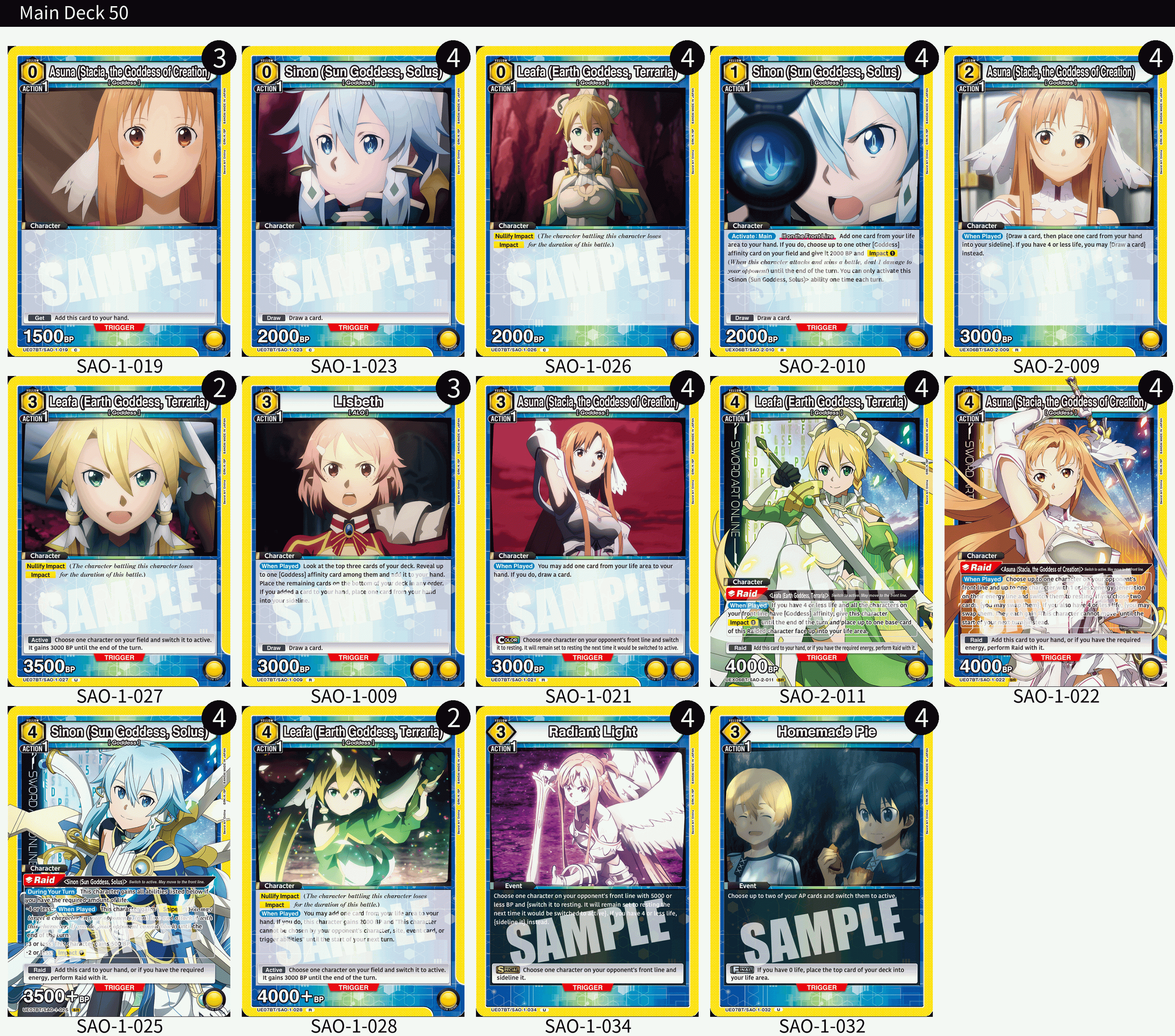
Yellow Goddesses is the only deck that can heal itself
Perhaps the single biggest advantage Yellow Goddesses have post Vol. 2 is that it is the only deck in the UNION ARENA English Version that can add life back. This is made possible thanks to the new Leafa Raid we get in Vol. 2 – one that brings the Goddesses strategy full circle.
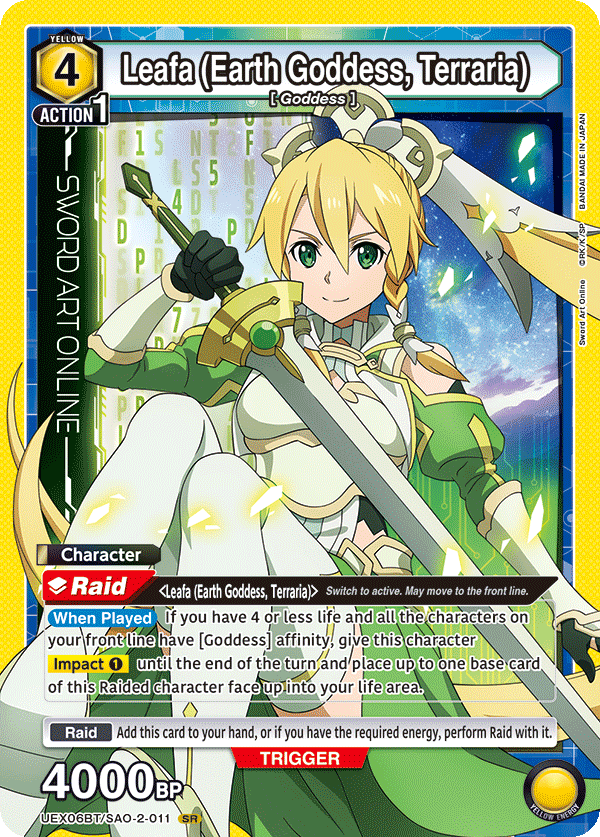
Leafa’s self healing ability is particularly useful given how much life you will be taking with your own abilities. Not only does she add an essential defensive layer later in the game, she helps justify the massive life drain effects like the three-cost Asuna or the one-cost Sinon leave.
Not only does she complete the Goddesses strategy thanks to this ability, she also acts as a replacement Impact character. Vol. 1 Goddesses relied on Eugeo’s Raid to get another Raid Impact character. However, the Eugeo package never felt 100% and Leafa getting Impact the turn she is played and healing your life makes her a must-have in your deck.
The only drawback for Raid Leafa? A lack of top tier Raid targets for her. Indeed, it’s this glaring lack of a solid Raid line for Leafa that is partly to blame for holding this deck back. You have a decently solid Raid target in the form of zero-cost Leafa. She has 2000 BP and Nullify Impact which is strong. However, you don’t have a three-cost two-energy gen character that would work wonders for this deck. As such, you’re forced to choose between either a somewhat awkward 3500 BP Nullify Impact Leafa and your four-cost Leafa to Raid over.
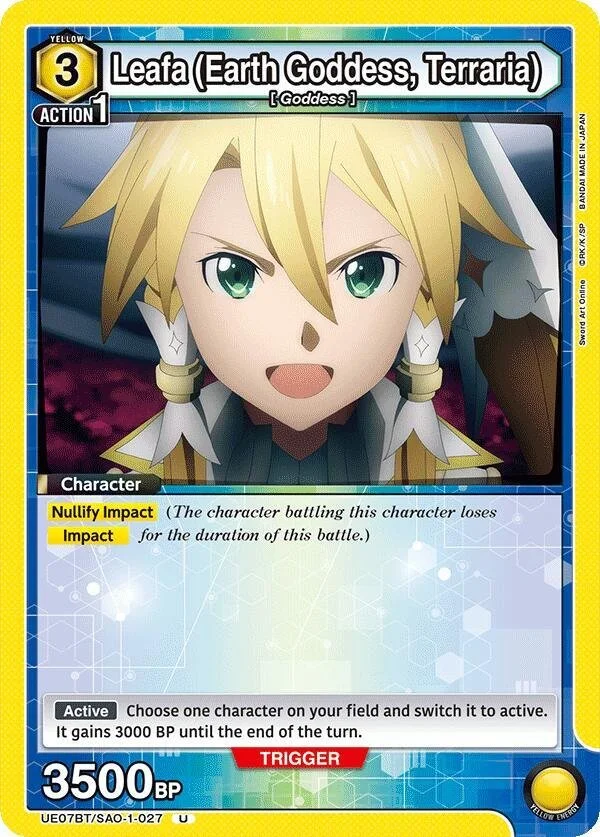
In my build, to help make this strategy more consistent (Leafa is so key to your strategy that you really do need it), I’m running two of the three-cost Leafa. This three-cost Leafa isn’t a terrible card – she does at least have decent BP and Nullify Impact. However, if we ever get a Sword Art Online Vol 3 set in UNION ARENA, I really hope they give us a two energy-gen Leafa to make this deck really sing.
At its strongest, Goddesses is one of the strongest decks in the game
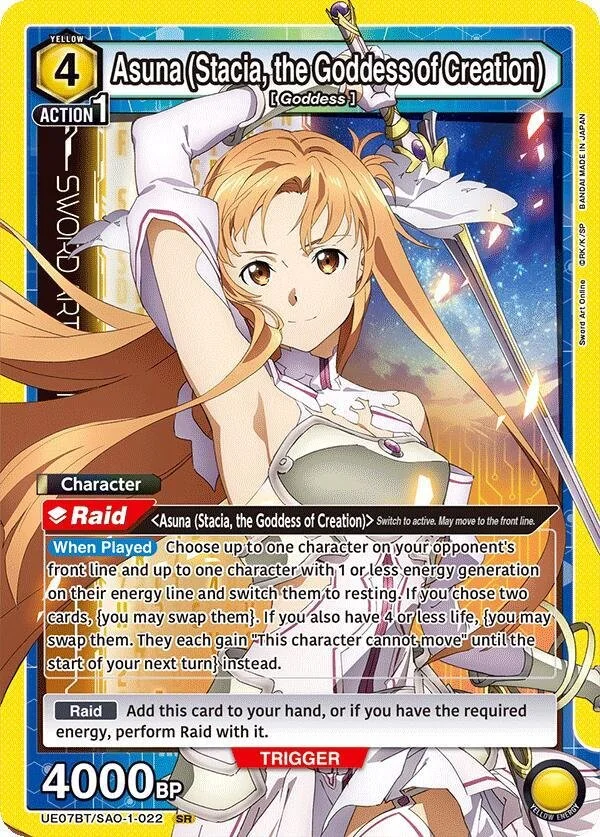
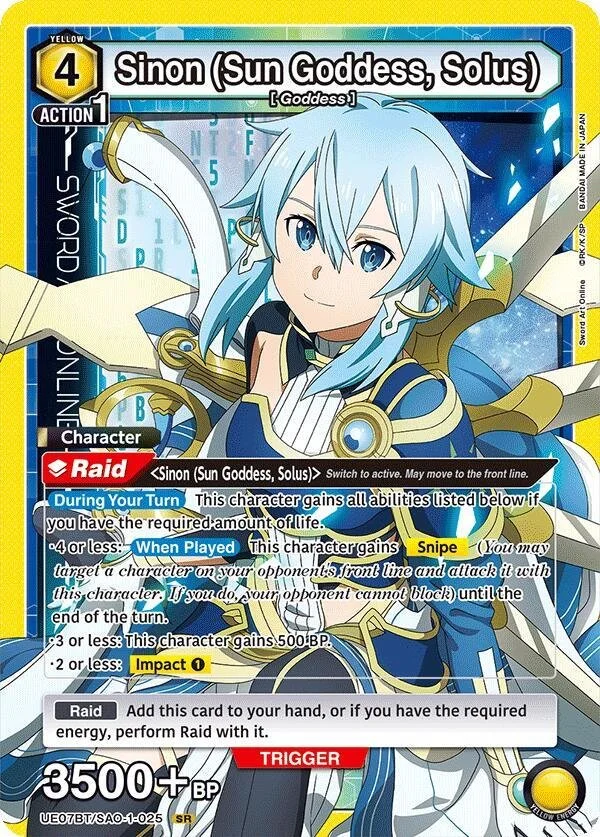
Despite some of its drawbacks, the biggest appeal of the Sword Art Online Yellow Goddesses deck is that at its strongest – it is easily one of the most powerful decks in the game. Combining things like Raid Asuna’s swap-and-freeze effect with Sinon’s Raid and Snipe with Impact at just four energy are pretty incredible. These plays have only gotten stronger with Vol. 2. One-cost Sinon pairs exceptionally well with your Raid Sinon – use her to boost Sinon by 2000 BP and give her Impact even at just four life – making her a 5500 BP Impact character with Snipe.
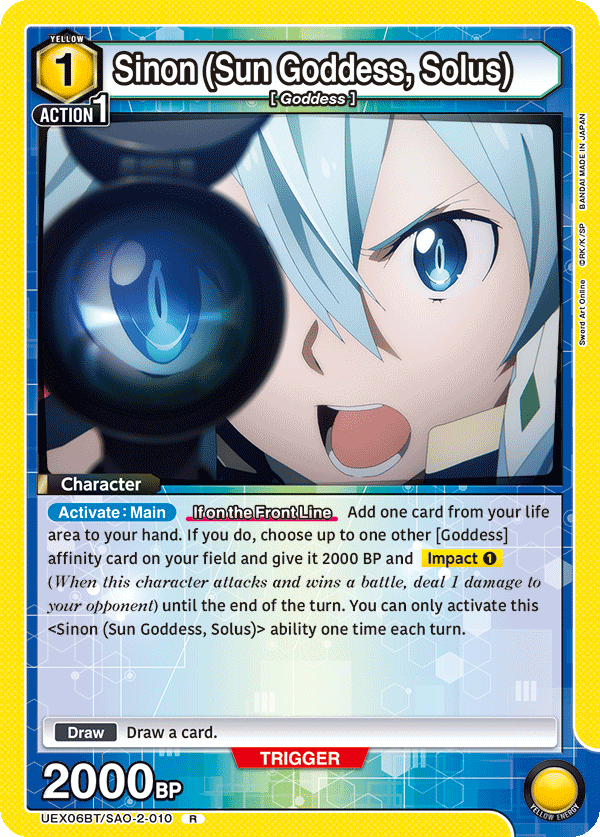
With the ability to Snipe very effectively and manipulate your opponent’s board while also providing solid healing effects, Goddesses is a very strong control deck. When everything is operating properly, SAO Yellow Goddesses feels like an absolute killer deck. However, I’ve played Yellow Goddesses enough to know that many times, things don’t go 100% as they should.
Goddesses does face some drawbacks
With great power, however, often does come great weaknesses. I wouldn’t go so far as to say that Yellow Goddesses has great weaknesses, however. More like minor drawbacks that make it just a hair behind in a massively competitive UNION ARENA playing field. I say this as someone with significant experience playing the deck, so I really do know what makes it work and what makes it suffer.
Managing life correctly adds considerable complexity
The greatest hurdle to Goddesses is the complexity level required to manage and implement its greatest plays. Namely, needing to systematically and methodically map your game to unlock the right effects at the right time adds a layer of complexity to playing this deck that simply isn’t there in other top tier decks.
Sure, with the likes of Saito you need to build up an energy line before sniping things with Impact at 5000 BP. However, that’s just one condition to work around and then you can essentially rinse and repeat your core strategy.
With Goddesses, however, you have to manage your life and map it to your effects. Needing to be at four life means you can’t do early game Special plays to aggro out your opponent, lock characters down early, or Snipe effectively. This makes Yellow Goddesses a fairly hard control-style deck – one that can be worked around in the early game if your opponent knows what they are doing.
The addition of being able to add life back adds further complexity to the deck, making it integral that you time effects perfectly. For example, playing a Sinon at four life to get the When Played Snipe, then Raiding the Lefa to put Life back – all of this needs to be properly sequenced in order to get right.
Weakness to rush plays
Perhaps the greatest weakness I’ve faced with Goddesses is into rush style plays. Simply put, a solid rush play early in the game before Goddesses can manage to get board set up can be absolutely deadly.
This is only compounded by the fact that in order to use all of its powerful effects, Goddesses needs to have life to take. For example, the three-cost Asuna is a very powerful card. She’s a two-energy gen Raid target while also letting you essentially draw two cards. One of those cards is from your life. Simply getting to play her early can massively advance your strategy – letting you see more cards, and setting up for big plays.
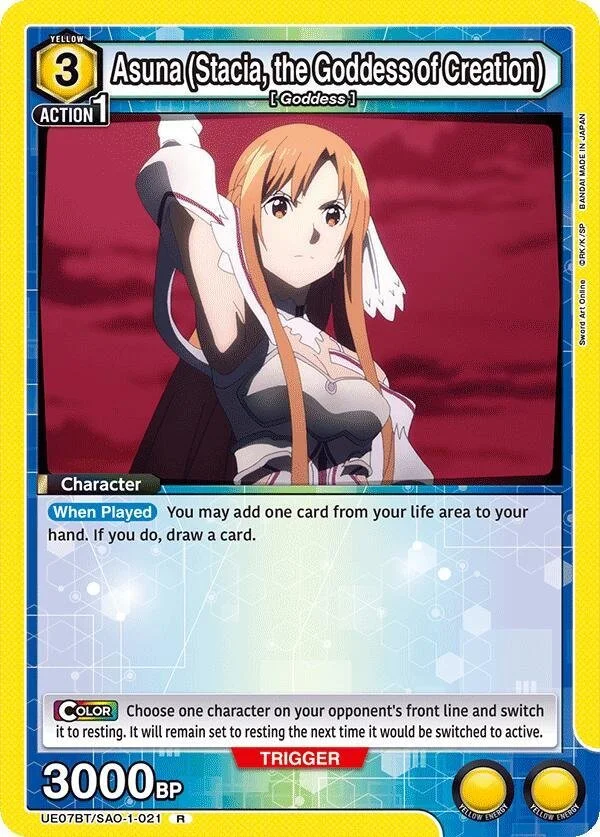
However, if your opponent rushes you down fast enough, it can make it very dangerous to use this When Played ability at all. While Leafa’s healing ability does mitigate some of this risk, it doesn’t eliminate it entirely.
Relatively weak, early game draw
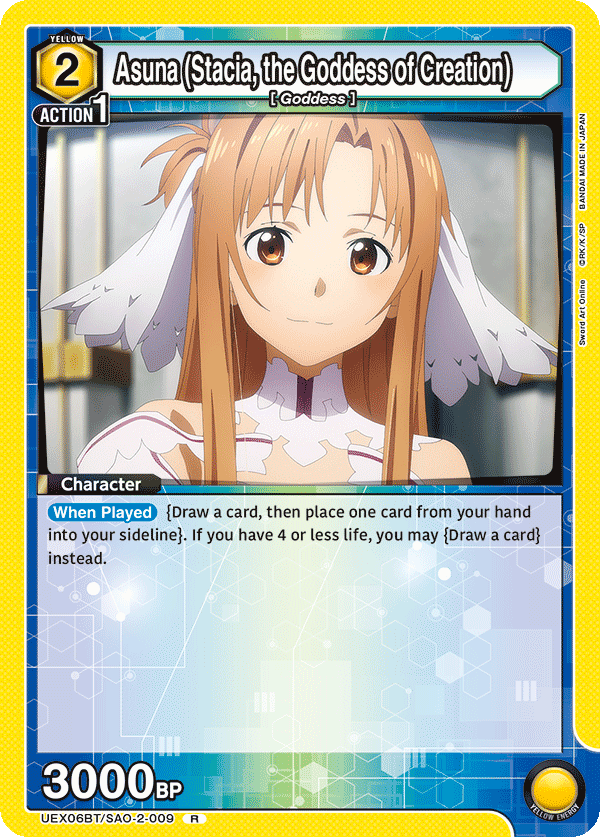
Lastly, despite having solid draw overall, Goddesses does suffer from a relatively weak early game draw situation. While the addition of two-cost Asuna in Vol 2. does help, it doesn’t remove this issue entirely. A zero-cost draw-one-sideline-one would help this card out greatly, as would a one-cost draw-one-sideline-one, letting you see the key cards you need to make your strategy work effectively more easily.
Goddesses’s greatest matchups
All of that being said, Goddesses is still a very strong deck easily making its way into the upper tiers of the UNION ARENA English meta.
While Goddesses will admittedly suffer to highly aggressive plays, where it really shines is in its flexibiilty to react to whatever your opponent is fielding. Into energy hungry decks, Asuna’s switch effect can be an effective means to disrupt the energy line. Meanwhile, into other midrange decks, Goddesses can react fast due to its lower energy threshold and overwhelm them. Into heavier control style decks it can often move faster than those decks can, solidifying the win before your opponent’s biggest characters come on line.
Rush plays or double attack decks are the most difficult for Goddesses to deal with. However, with the addition of the heal mechanic, it really does feel like an entirely different deck – one that (in the right hands) can dominate the playing field.